Global challenges require more than predictive models. They require systems that can learn, adapt, and remain accountable as conditions change.


AI FOR GOOD: FROM PRINCIPLES TO PRACTICE
for good>

<Trustworthy AI>
is built through visibility and oversight
Trust in AI is earned, not assumed. We design systems where decisions can be traced end-to-end: what data was used, what assumptions were made, and what changed over time. Every solution deployed includes continuous monitoring, audit logs, and human-in-the-loop oversight. This allows teams to challenge outputs, intervene when needed, and continuously improve performance rather than treating AI as an opaque authority.
Fairness and bias are treated as measurable system properties, not abstract ideals. We track performance across subpopulations, monitor drift and disparity over time, and surface these signals alongside core equity metrics. Where appropriate, equity constraints are built directly into decision-making algorithms, shaping how resources are allocated rather than being assessed after the fact

<Good decisions>
start with disciplined data
Better decisions start with better data, not more of it. We prioritize purpose-limited collection, strong governance, and robust pipelines that preserve data quality from capture to deployment. Privacy-by-design, security, and anonymization are defaults, embedded in the infrastructure rather than added later.
This discipline is essential for fairness and reliability alike. Clean, well-governed data enables meaningful bias monitoring, prevents spurious optimization, and ensures that learning reflects real system behavior rather than artifacts of measurement

<Equity>
requires inclusive design and evaluation
AI systems should work for those who are hardest to reach, not only for those best represented in historical data. We design with local partners, test across populations and contexts, and explicitly evaluate performance gaps. Equity constraints, participatory feedback loops, and diverse teams are practical tools we use to reduce bias where it matters most: in decisions that affect access, quality, and outcomes

<Impact>
comes from accountable learning in the real world
In high-stakes domains, accuracy is not the finish line. Outcomes are. We validate models in the field, define guardrails for safe operation, and continuously learn from interventions while protecting users from unintended harm.
Our goal is durable improvement in outcomes, resilience, and access, supported by systems that can adapt as conditions change

<AI Infrastructure for the Sustainable Development Goals>
These principles come to life through adaptive AI infrastructure that supports the SDGs in practice. We build learning systems that turn real-world data into better decisions for health systems, supply chains, and governments, integrating data, decision-making, and evaluation into a continuous loop. This approach allows institutions to improve performance while maintaining transparency, equity, and accountability at scale.
Our work is grounded in the UN Sustainable Development Goals, with a particular focus on Good Health and Well-Being (SDG 3), Industry, Innovation and Infrastructure (SDG 9), and Partnerships for the Goals (SDG 17).


SDG 3 - GOOD HEALTH AND WELL-BEING
Building Learning Health System
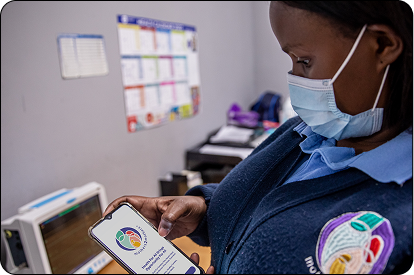
We work with governments, NGOs, and health providers to turn fragmented health data into real-time, adaptive decision support. Our infrastructure powers tools such as CHARM, an AI-native platform for community health workers, and dynamic capitation models that align financing with population needs and provider performance.
These systems apply the same AI for Good principles in clinical and operational contexts: traceable decisions, fairness monitoring across patient groups, and guardrails that protect against unintended harm.
From risk-based follow-up in maternal and child health to AI assistants that summarize clinical notes and surface red flags, our focus is helping frontline teams deliver the right care, to the right person, at the right time.


SDG 9 - INDUSTRY, INNOVATION AND INFRASTRUCTURE
Adaptive AI Infrastructure for Real-World Systems
<kenkai>, our adaptive AI platform, provides the learning infrastructure organizations need to move beyond static reporting. It integrates data ingestion, experimentation, machine learning, and reinforcement learning into a single system that learns from every interaction.
By embedding fairness monitoring, performance evaluation, and governance directly into operational infrastructure, <kenkai> supports faster and more resilient systems without sacrificing oversight. We apply this across sectors: optimizing pharmaceutical and FMCG supply chains, improving demand forecasting and routing in last-mile logistics, and personalizing digital customer journeys in ways that remain auditable and controllable.
By embedding AI into the core of operational infrastructure, we help partners build systems that are faster, fairer, and more resilient, ensuring that optimization does not come at the expense of access, service quality, or smaller actors in the system.



SDG 17 - PARTNERSHIPS FOR THE GOALS
Partnering to Scale What Works
Causal Foundry was built on the belief that no single organization can solve systemic problems alone. We collaborate with governments, multilateral agencies, foundations, and companies to co-design AI solutions that respect local context and existing systems
Our role is to provide the adaptive AI layer: data infrastructure, models, experimentation frameworks, and governance tools.
Partners contribute domain expertise and trusted relationships on the ground. Together, we turn pilots into platforms, scaling from individual clinics to national health systems, and from single supply chains to regional networks.